Yacht interior refit: materials, furnishings and bespoke details
·Studio Daniela La Rosa·12 min read

In this guide
A refit begins with an inventory of what works and what needs to improve. Decisions to retain, restore or replace elements should reflect how each space is used. Shared samples, drawings, access requirements and approvals help renew the interiors while respecting the character of the existing yacht.
A yacht interior refit is an opportunity to reconsider the boat in light of how it is used today. The owner's needs may have changed, some materials may have deteriorated and certain furnishings may make the spaces less practical than expected. Interior design starts with that existing situation, identifying what deserves to be retained, what can be restored and what would benefit from renewal. Those decisions give the project a clear purpose before a new palette or a collection of products is selected.
The objective is a coherent interior and a better experience on board, supported by choices that can be checked and discussed. Fabrics, finishes, lighting, storage and joinery need to work with the existing yacht, the shipyard and the people who manage it. This guide helps owners prepare a brief, assess samples and organise approvals so that the refit develops as a considered whole. Its examples are design scenarios for comparing alternatives and clarifying priorities before work begins. They provide a framework for discussing the actual vessel, rather than a list of replacements to approve in isolation.
1. Taking an inventory before deciding what to change
The first phase should document the current state of the spaces. Photographs, surveys and observations of use help to recognize wear, finishes that are difficult to maintain, containers that are difficult to access and details that no longer correspond to on-board habits. It is helpful to watch the boat as it is being used, not just when it is being prepared for a visit. Objects left on supports or continually moved often indicate an unresolved need for storage.
For each element, a distinction can be made between conservation, restoration and replacement. A well-proportioned piece of furniture may only need a new finish; a seat may require a different covering, while maintaining a still valid structure. Other elements may deserve a more extensive redesign. The decision must be made after an adequate evaluation, avoiding both the automatic replacement of everything that exists and the conservation of elements that compromise the desired result.
It is best to associate a simple note with the photographs: what works, what creates discomfort, what improvement is desired. This material constitutes a concrete brief for the interior designer and allows proposals to be compared with recognizable needs. It is also a basis for explaining to the shipyard which interventions are being evaluated and what technical information is needed before proceeding.
2. Defining the scope and sequence of the refit
The term refit can include very different interventions. Renewing fabrics and accessories is not the same as modifying integrated elements or redesigning an entire cabin. Before discussing the aesthetic result, it is important to establish which spaces are involved, which parts remain and which activities require the intervention of the shipyard. A clear perimeter makes the proposals comparable and helps to identify the decisions that will influence subsequent ones.
The sequence should take into account access, work and the boat's usage schedule. Some items can be prepared off the yacht; others require on-site testing and adaptation. The protection of what is stored must also be planned. The interior design contributes by ordering samples, drawings and approvals, while operating times and methods of execution are agreed with whoever will carry out the intervention.
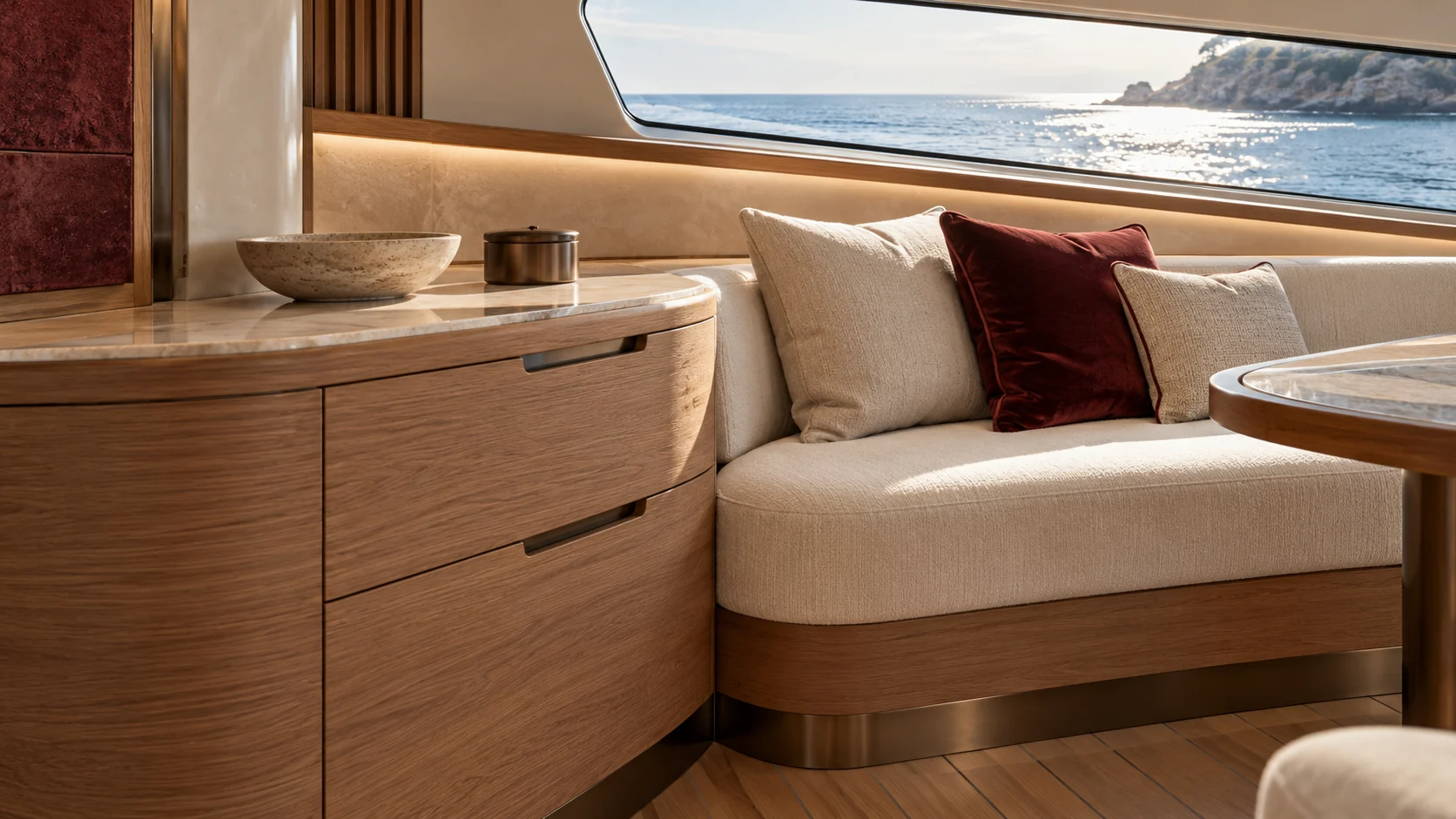
3. Developing a new direction that respects the yacht
An existing boat has proportions, openings and details that participate in its identity. The project can update the reading without deleting any recognizable element. A new palette can give greater continuity between spaces; a fabric can make a very rigid composition softer; a finish can reduce contrasts that have become less than harmonious. The quality of the change depends on the relationship with what remains, not on the quantity of innovations introduced.
The reference images must be commented precisely. Do you appreciate the light, the texture of a covering or the feeling of order? Copying a room photographed on another yacht risks ignoring differences in geometry and use. It is more useful to recognize the principles of interest and translate them into real boat conditions. A well-explained concept allows you to maintain a direction even when some products must be replaced with alternatives.
4. Selecting fabrics for their location and use
Fabrics are among the most visible elements of a refit, but the selection requires more than a good color match. You need to know where each seat will be placed, how much it will be used, what exposure it will face and how it will be cleaned. A fabric suitable for a protected cabin may not be the right choice near external access. The specification must refer to the actual product and its application.
The sample must be observed in adequate dimensions and next to existing materials. Texture, direction of the design, stitching and shape of the cushions modify the result. When preserving a structure, it is best to check with the upholsterer how the new covering will behave on the real volume. A stiffer fabric or a very obvious texture can change the reading of the seat, even when the color seems similar to the previous one.
Maintenance should be discussed before approval. In its directions for nautical fabrics, Sunbrella links regular care to cleaning, gentle rinsing and drying, with instructions that depend on the product. The design criterion is to prepare a procedure compatible with the chosen fabric, without applying universal recipes or transferring indications between different coverings.
5. Comparing finishes through a selection schedule
Woods, panels, tops and coverings must be compared considering appearance, application and maintenance. For a material intended for furniture, it is also useful to discuss edges, joints, support and repair possibilities. The same surface may appear convincing in a small sample and show too strong a character over a large area. A more representative test allows these effects to be recognized before production.
The selection schedule should collect the precise reference, finish, place of use and necessary documents. For relevant naval applications, the IMO FTP Code covers fire test procedures for materials and components. The verification of which requirements apply to the boat and the intervention is the responsibility of the shipyard and the specialists in charge. A trade name or cosmetic similarity alone does not demonstrate the suitability of a substitution.
| Choice | Visual evaluation | Information from collect |
|---|---|---|
| Coating | Texture, color, stitching | Intended use and care |
| Furniture finishing | Reflection, grain, edges | Swatching and restoration |
| Top of support | Thickness and joints | Support and application |
| Hardware | Integration into design | Compatibility and accessibility |
6. Redesigning joinery around its functions
In the refit the joinery should resolve identified problems. A container can become more accessible, a compartment can accommodate devices that are currently absent, a headboard can integrate supports and reading lights. The drawing must be verified together with the existing geometries and technical accesses. Even when the change appears limited, it is necessary to understand which parts will be dismantled, how they will be connected and which finishes will remain visible next to the new ones.
The detail of the openings deserves specific discussion. A hollow grip, a handle or an integrated system have consequences on the gesture of use and the reading of the surface. The solutions must be agreed with those who produce and know the needs of the boat. The continuity of the grain and the alignment of the fronts are important, but they must coexist with the possibility of opening, cleaning and inspecting the necessary elements.
When working on a single room, it is advisable to identify the connection points with the rest of the yacht. A new piece of furniture doesn't necessarily have to replicate every existing detail, but it should explain its relationship to them. A common tone, a profile or a recurring finish can connect different phases of the refit, allowing you to renew by priority without losing coherence.

7. Reviewing lighting alongside the new finishes
A lighter finish, a different fabric or a new arrangement of furniture can change the perception of light. This is why the refit offers the opportunity to review the lighting project together with specialists. It is useful to distinguish between general light, activity points and accents, identifying situations where the current environment is difficult to read or too uniform. The requests must be linked to concrete gestures, such as reading or using a support surface.
Integrated light requires attention to the surfaces it illuminates and the positions from which it is observed. A bright line can enhance a piece of furniture, but also highlight an imprecise connection. Sources may appear in reflective materials that were not evident in the render. Tests and samples help evaluate the real effect and discuss the necessary adjustments, avoiding considering lighting only as an accessory to be chosen once the project is completed.
8. Planning access, installation and detailing
An item designed for the cabin must be able to reach the cabin. Doors, stairs, passages and assembly sequences affect how it is built. Before placing orders, it is necessary to share this information with the shipyard and suppliers, checking whether removable elements or work to be completed on site are necessary. This comparison also protects the quality of the finishes, because it allows you to intentionally design the connections that will remain visible.
Logistics includes what will be temporarily removed and what needs to be protected. Fabrics, glass, preserved surfaces and already completed parts require an organization consistent with the planned processes. The designer can contribute through a list of elements and precise documentation, while the execution is coordinated by whoever manages the refit. Clarifying responsibilities and steps reduces interpretations and makes it easier to verify the result upon delivery.
9. Managing samples, substitutions and approvals
During the project, alternatives may emerge due to availability, processing or compatibility. Each substitution should be compared to the approved proposal and neighboring elements. It is useful to keep a list that distinguishes selected materials, samples yet to be confirmed and ordered products. A photograph or similar name is not enough to demonstrate equivalence, especially when it changes the texture, reflection or tone of a large surface.
The economic comparison should refer to clear contents. Does a proposal include only the upholstery or also the necessary work on the seat? Is the furniture supplied finished and installed? Is the required evidence included? These questions help you understand the differences between offers. It is preferable to discuss a precise scope rather than assume that amounts referring to the same environment automatically describe the same work.
Documenting decisions also protects the project over time. Recording fabric references, finishes and approved details allows you to tackle repairs and extensions with greater precision. A refit can have successive phases, but each should leave understandable information for those who will resume the work. Continuity depends on the quality of this collection, as well as on the memory of the people involved.

10. Checking the result through everyday use
Delivery should include a reading of the spaces under intended conditions of use. Opening the containers, sitting down, reaching the supports and experiencing the light scenes allows you to recognize aspects that a photograph does not tell. Any observations must be collected precisely, distinguishing what still needs to be completed from the indications necessary for ordinary management. A shared comparison is more useful than an evaluation based only on first impressions.
It is important to leave simple information to those who will use the boat: installed materials, care instructions, supplier references and indications of the elements that can be removed or replaced. If a crew is present, their involvement makes this collection particularly concrete. The project continues to work when the details are understandable and maintenance can respect the characteristics of the products actually chosen.
Keeping decisions clear with a project log
A simple log can accompany the entire refit. For each environment, initial problem, proposed solution, reference sample, person who approves and decision status are noted. You don't need a complex document: you need the information to be updated and shared with whoever needs to use it. Its usefulness grows when different processes proceed in the same period and an aesthetic choice influences activities carried out by different suppliers.
Let's take a hypothetical example: the approved fabric for the salon bench is not available in the quantity needed. Before accepting an alternative, color, texture, volume behavior and documented characteristics for the intended application are compared. It is also checked whether the replacement involves other elements already selected, such as cushions, curtains or nearby coverings. The register retains the new reference and approval date, so that the order is not initiated using outdated information.
The same method applies to a joinery modification. If a size or position changes, the updated drawing must make the revision identifiable and indicate which other parts need to be checked. An informal conversation can be useful to quickly resolve a doubt, but the agreed solution should then appear in the document used by the producer. This step avoids having different people working on different interpretations of the same request.
Upon delivery, the register can become an orderly collection of final references, attachments and directions for editing. We distinguish what has actually been installed from the alternatives not chosen, retaining only information useful for future management. It's an unspectacular detail compared to a photograph of the interior, but it contributes to the duration of the project: it makes more precise substitutions possible and allows work to be resumed without rebuilding all the decisions from scratch.
Knowing where to start
If the problem is above all the atmosphere, you can start from a comparison between palettes, fabrics and light. If there is no support or storage, it is best to first analyze the functions and designs of the furnishings. If the spaces no longer correspond to on-board habits, a broader brief involving distribution and coordination with the shipyard is needed. Identifying the nature of the need avoids asking a new finish to solve an organizational problem.
The guide to yacht interior design and the design of on-board spaces delves into this reasoning from the initial phase. To discuss an intervention you can consult the interior design for yachts service, preparing updated photographs, available documents and a list of priorities. A well-planned refit makes the character of the boat clearer and restores value to the moments you want to experience on board.
From the journal to your project
Life on board, designed around you.
Tell the studio about the spaces, needs and priorities of your project.
Discover Daniela's teaching and mentoring.